Relay outputs
DO channels use relay outputs rated up to 10 A for common AC/DC switching tasks.
The Y311 family covers compact relay control nodes and medium to high-density remote I/O modules. Each point size is available in two network variants: -W for 2.4 GHz WiFi and -R for 10/100M RJ45 Ethernet.
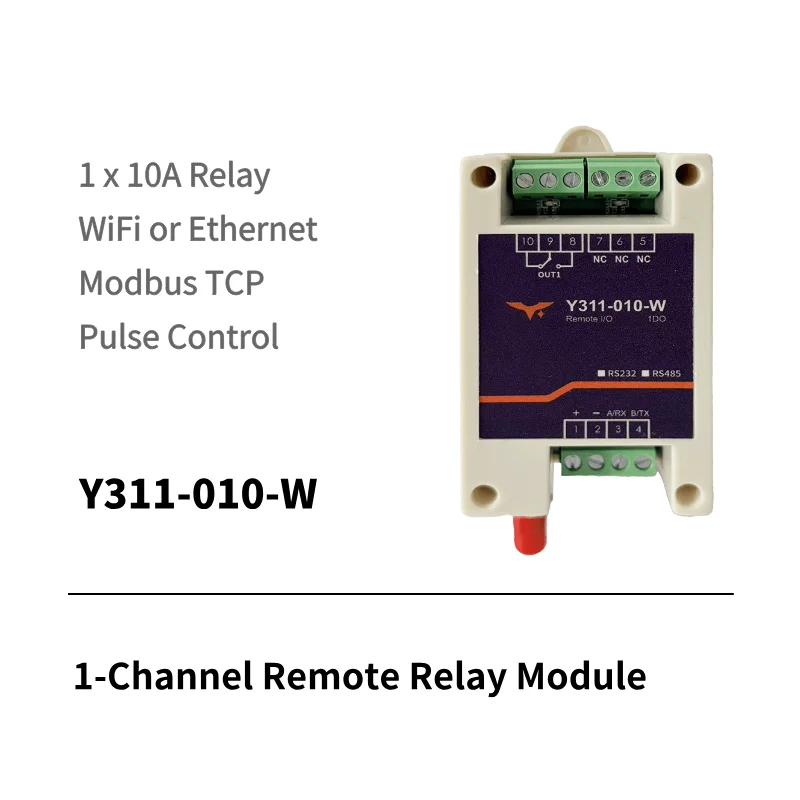
DO channels use relay outputs rated up to 10 A for common AC/DC switching tasks.
Use -W for wireless deployment and -R for fixed wired network environments.
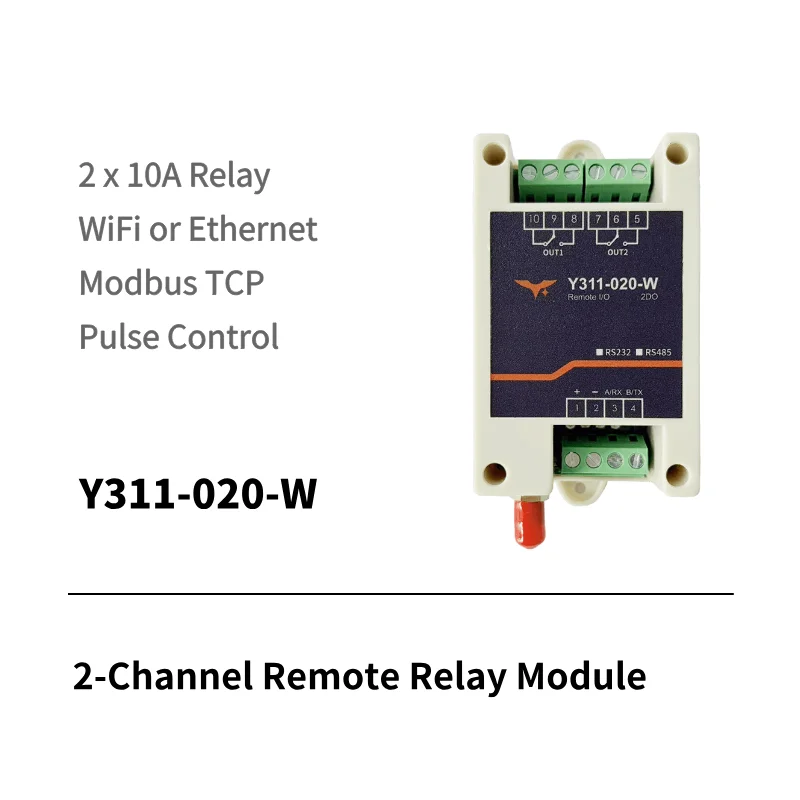
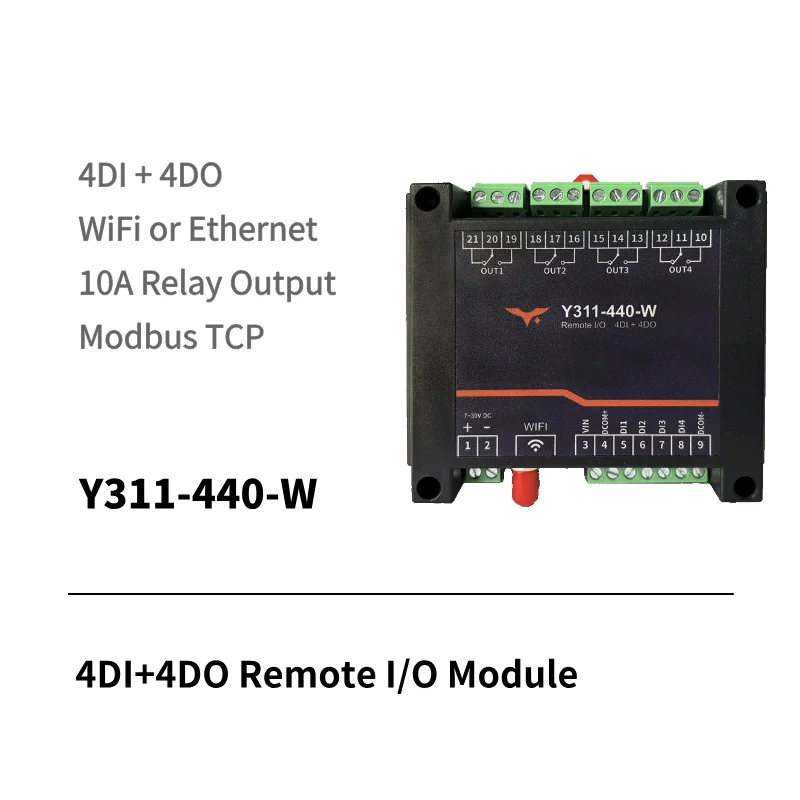
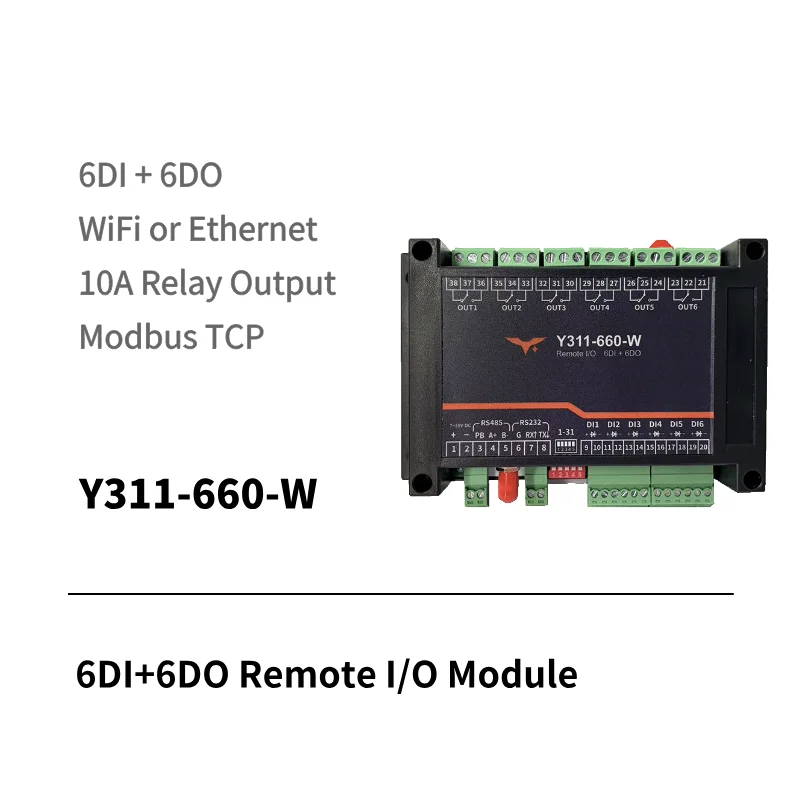
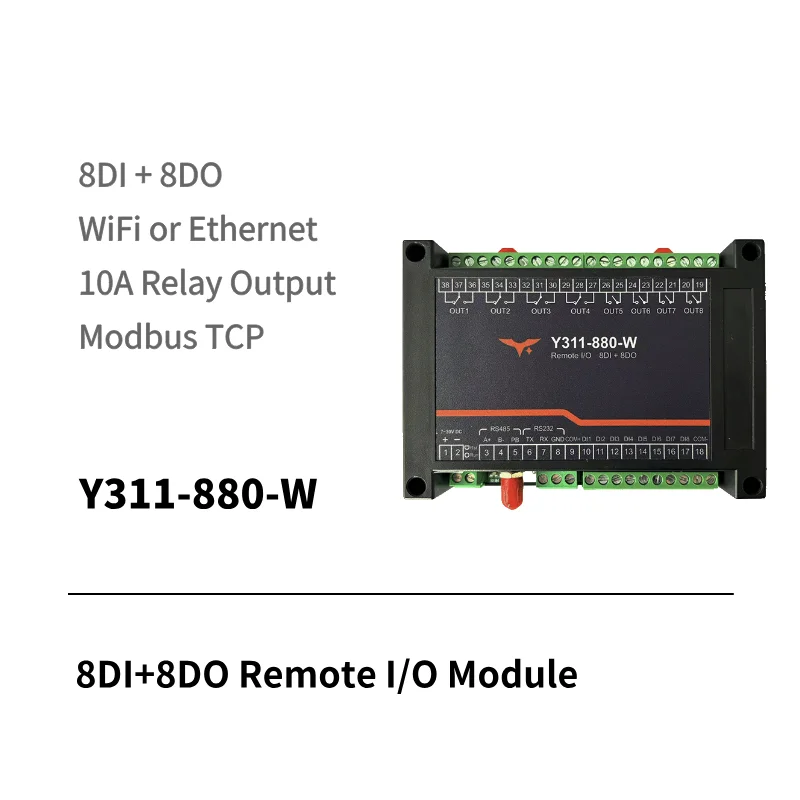
Models range from 1DO and 2DO relay-only modules to 4, 6 or 8 DI + DO combinations.
Wide DC power input and compact enclosures support installation in distributed cabinets.
| Model Family | DI | DO | Relay Rating | Connectivity Options | Power Input |
|---|---|---|---|---|---|
| Y311-010 SKUs: Y311-010-W / Y311-010-R | 0 | 1 × relay | 10 A | -W: 2.4 GHz WiFi (AP/STA) -R: 10/100M RJ45 Ethernet | 7-40 VDC |
| Y311-020 SKUs: Y311-020-W / Y311-020-R | 0 | 2 × relay | 10 A | -W: 2.4 GHz WiFi (AP/STA) -R: 10/100M RJ45 Ethernet | 7-40 VDC |
| Y311-440 SKUs: Y311-440-W / Y311-440-R | 4 | 4 × relay | 10 A | -W: 2.4 GHz WiFi (AP/STA) -R: 10/100M RJ45 Ethernet | 7-40 VDC |
| Y311-660 SKUs: Y311-660-W / Y311-660-R | 6 | 6 × relay | 10 A | -W: 2.4 GHz WiFi (AP/STA) -R: 10/100M RJ45 Ethernet | 7-40 VDC |
| Y311-880 SKUs: Y311-880-W / Y311-880-R | 8 | 8 × relay | 10 A | -W: 2.4 GHz WiFi (AP/STA) -R: 10/100M RJ45 Ethernet | 7-40 VDC |
Compare the I/O point count, network type and integration method.
STEP 1
Use 010/020 for relay-only control. Use 440/660/880 when you need both DI monitoring and relay output control.
STEP 2
Select -W for wireless deployment and quick onsite setup. Select -R for stable wired Ethernet networks.
STEP 3
For SCADA, PLC, and gateway integration, use the Modbus TCP register mapping from the technical manuals.
Direct links for product-level datasheets and shared technical manuals.
Product-level specifications and model details for each point-size group.
Protocol details, register maps, wiring notes, and commissioning instructions.
Note: W and R variants share the same I/O point count and control logic. The primary difference is network interface and default network settings.
Send the required interfaces, point count, protocol and site conditions.